
In this section we would like to bring real stories of how change and transformation is happening across Africa in families, villages, cities and nations. Watch this space for real, life changing testimonies and strategies from on the ground.
The Gambia
Mamo was about 6 months old when Ele showed up on his family’s compound in the Gambian village. He grew up knowing us as his older siblings and coming into our hut to ask questions and watch the candle drip wax. His two biggest dreams growing up seemed to be going to school and getting a bike. Neither happened as his father opposed Western education and there wasn’t enough money for a bike. But about 6 years ago he started hanging out at Erik’s welding shop. Within a year he was learning to weld and after a few years he was actually getting pretty good at it. He absorbed the learning like a sponge, even learning a lot of math and some reading in the process. A bike came along sometime. Now he’s one of the better welders around, even making compressed earth block presses and other complicated devices. While Erik has been gone for a sabbatical year, it’s been him running the shop. At one point Ele needed to get a fair sum of money to the village and he said, ‘No problem, I can lend it to you until you return.’ That’s a pretty big thing for an uneducated 22 year old village boy. Transformed by a bit of knowledge and now hungry for more.
Erik & Ele Brohaugh
Kenya
For the last 12 years, we have followed a transformation programme in a traditional, subsistence farming village community in the Shimba Hills Region of South east Kenya by:
Spiritual health – each year, local students are given the opportunity to spend 6 months learning the truth about God and taking part in outreach programmes. This Discipleship Training School helps to transform local church youth group members so that they can encourage, teach and provide leadership to other youths in their local community.
Agricultural training – traditional subsistence farming is ineffective, inefficient and causes environmental degradation. Training is provided in improved farming systems to increase local food security in a more sustainable way. We demonstrate Farming God’s Way as well as improved dairying with a small herd of local zebu cattle.
Medical provision – a local medical clinic meets immediate medical needs and Community Health Workers provide preventative community health teaching. The medical staff are Kenyan and the Doctor is a member of our local community.
Widows and orphans – with no local formal employment, young single mothers and widows can be forced into prostitution or trafficked to the Middle East. By providing some of these women with paid work and giving sewing and tailoring training, we enable them to provide for themselves.
Martin & Judy Heath
Zimbabwe
In July 2000 God led us to do ministry in one of the poorest communities of Zimbabwe called Mthombothemba. The community had the highest crime rate in the whole country of Zimbabwe. The Police force were in the process of building up a police camp in the community to help in curbing crime in the community. Apart from having the highest crime rate, the HIV/AIDS prevalent rate in the community was the 2nd highest in the land. People were dying of HIV/AIDS on a daily basis to a point that some bodies would decompose either in the mortuary or at home before being buried. Sometimes the community would bury 3 people in a day and this literally led the community to be tired of burying the dead. This highest adult mortality rate led to many children in the community being left without parents. We found out that 75% of the children at the local primary school were orphans. The community of Mthombothemba is in region 5 of Zimbabwe which is the drought prone area where they receive very little to no rainfall per annum. At the time when we went into this community there was hunger and starvation all over the area due to perennial droughts. Christianity was forbidden in this community because people worshipped ancestral spirits.
We worked in this community from running a coffin project where we were just burying the dead to running various community dialogues to improve the quality of life in the town. The community which used to be the poorest in the nation is now one with very wonderful gardens that people are running and many people are learning a lot from this community. Through the grace of God at the end of our 16 years of ministering in this community, the community was declared a Christian community by the leaders of the area. We saw God moving the people of this community from worshipping ancestral spirits to a place of worshipping the true God. We have seen God improving the quality of life in the community when people turned to him and realised that change starts by realising truth. The crime rate dropped because many people are now Christians, such that the Police force had to abandon their project of building a police camp in the community. The pass rate at a local primary school improved from 3% to 85%. Miraculously gold was discovered in the community and the community members now have another source of livelihood.
Gideon & Jennifer Chishamba
Madagascar
In 2004 YWAM were able to start a health care project in Tamatave, Madagascar. This came about after a time of research, which revealed a desperate lack of health care, they decided to help remote villages create their own clinic. The government health department and other established NGO’s told them this was impossible as the villagers were uneducated, lazy and uncooperative! 16 years later there are 50 self-financing health posts run by local Malagasy people, serving around 200,000 villagers who used to walk for many miles to receive any health care.
The team also discovered that in the more remote villages, outside of Tamatave town, there were no believers. So, alongside the health work they were able to expand the existing church planting ministry. They trained local young people as church planters and today there are more than 150 local churches each with a leader trained by YWAM.
Over the years we have added several elements of ministry to influence the spheres of society. These include working with pre and primary schools, business groups, women’s enterprise training, discipleship training and youth ministries. This year, 2020, we appointed an all Malagasy leadership team. All three of them started as young church planters and through excellent leadership development have taken on more responsibility.
Recently, we started looking at the whole area of food security. A small team from MM-Madagascar started researching crops, growing methods and animal raising. As a result, we have a long-term plan to: create a model farm where communities can see effective methods as well as learn more efficient ways to grow crops and raise animals, train the local youth and those from other provinces in agriculture and life skills so they can be change agents in their communities, generate funds through efficient agriculture and animal-raising to support our ongoing health, children’s and church planting work.
Dave Swann
Africa
In these two photos below, you see for me the hope for Africa. I believe God’s heart is that no child in Africa would go to bed hungry at night. In the last years, I’ve had the privilege to run Farming God’s Way training sessions in several communities in Africa. from Kenya to Mali.
This technique combines worldview ideas, biblical values, and technical training. It attacks the roots of poverty as well as the concrete reality of producing more food. As we train farmers and their families discover the dignity that God intended for those who work the ground. The hope that is born when we can feed our family is often an open doorway to tackling other challenges in the community.
Both of the photos were taken in the same week one is an average field from the Makwangani in Kenya. The other the farming God’s way trial plot. I think the difference speaks for itself, but from an average yield for subsistence farmers of 350kg per hectare, we would hope using local seed, compost created on the farm, and a thick layer of mulch to harvest 5000kg a hectare.


If you’d like to learn more about Farming God’s way their website is:
https://www.farming-gods-way.org/
Richard Leakey
Niger
I have had the privilege of being involved with a project called Sowing Seeds of Change in the Sahel (SSCS) since 2013, which works in the areas of agriculture and community health. But as an agronomist I have predominantly been involved with the agricultural side of the work. As Christians we believe that God has entrusted the earth to us to take care of (Gen. 2:15). However, this has been spoiled and influenced by man choosing not to do so responsibly. In order to explain what this may look like in practice, let me share what at SSCS we have, among others, been working on.
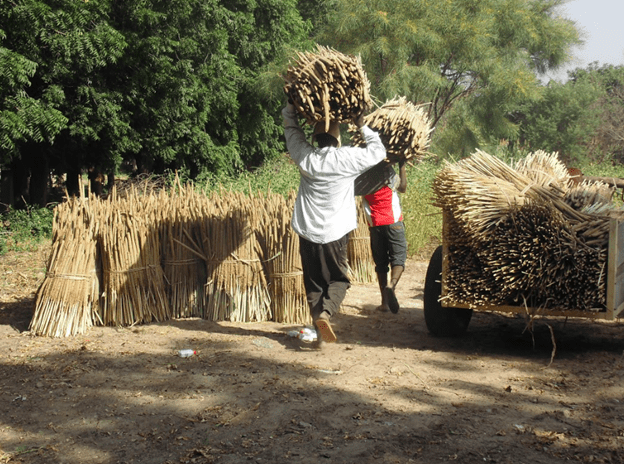
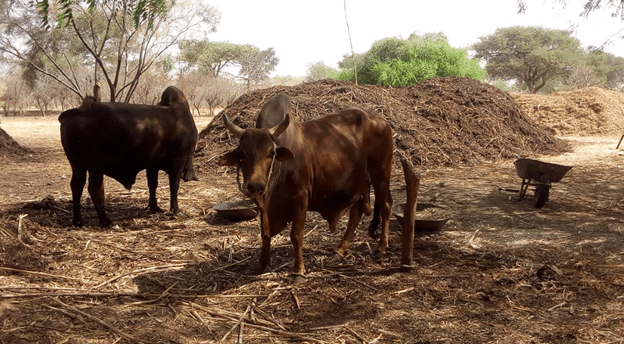
Looking around in the area of Maradi in Niger, it doesn’t take much to understand that agricultural practices in recent history have had a destructive influence on the environment (deforestation and loss of soil fertility). At SSCS we have the responsibility of managing a farm of 23 ha. Our predecessors already started working on preserving/regenerating and planting trees on the property, and over the past 7 years we have worked on taking additional measures to restore soil fertility mostly by bringing in significant amounts of manure to spread out on the fields as fertilizer – or in other words: to give back to the soil what we had taken from it the years before at harvest time. In 2018 however, as a result of progressively improved soil fertility in combination with some other management techniques we reached a point where the crops produced so well that on top of a good harvest, we had a very good amount of crop residues. We combined this with the manure our own two bulls (draft animals) had produced over several months and converted it into compost. The amount of compost this gave us was enough to spread out on the fields for the next cropping season; we no longer needed to bring in manure.
This is our story in a nutshell, but of course the point is that we are clearly seeing the difference between the productive (or constructive) results of working in a way that is in accordance with God’s mandate to take care of creation and the unproductive (or destructive) results of ways of working that do not take care of creation. And I think that this is the challenge for all of us; to look around us and think about ways in which we can help being productive/constructive contributors in the care for God’s creation, or to reflect on ways in which we are being either good or bad stewards of this earth that God has entrusted to us.
Jeannette Gaitou
 africa-transformation.com